
6 Ways Airline AI Takes Flight—from Booking to Touchdown
Discover how airline AI revolutionizes travel, cutting costs and boosting efficiency, from 40% better forecasting to saving 480,000 gallons of fuel in 6 months.
By Paul Estes
What is AI in aviation?
The airline industry—the cornerstone of global connectivity—faces many challenges in its quest for efficiency, profitability, and customer satisfaction. From optimizing routes and managing connections to predicting demand and maintaining aircraft, airlines grapple with complex issues that significantly impact their bottom line and the overall passenger experience. Enter airline AI—a game-changing technology revolutionizing air travel from when a ticket is booked to the final touchdown at the destination.
The Turbulent Skies: Challenges in Modern Aviation
Airlines operate in a high-stakes environment where every minute saved and every gallon of fuel conserved can make a substantial difference in profits and operational health. The challenges are numerous and interconnected, each having a ripple effect on operations, costs, and customer satisfaction:
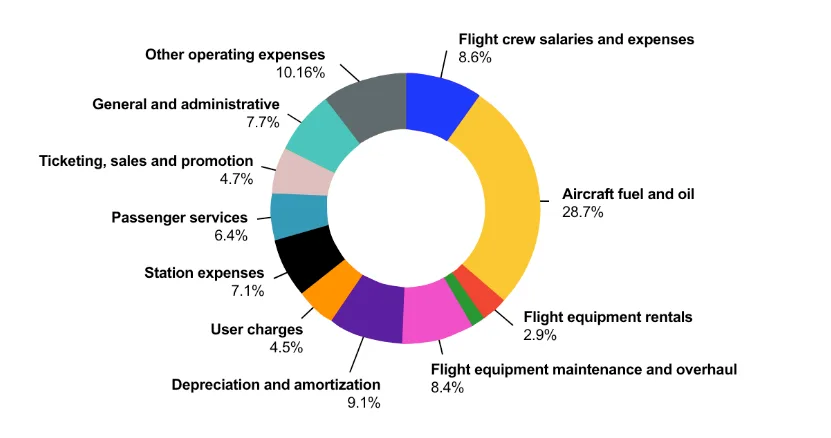
- Fuel Efficiency and Route Optimization: Fuel costs represent 20-30% of an airline's operating expenses, so a 1% reduction in fuel consumption can save large carriers millions annually. This underscores the critical importance of route optimization and fuel management.
- Connection Management: Roughly 20–35% of passengers require a connecting flight, with that percentage growing to as much as 70% at major hub airports. Misconnections cost the airline industry billions of dollars annually in rebooking, compensation, and lost revenue. Even a 10-minute delay at a hub can cause significant delays for passengers.
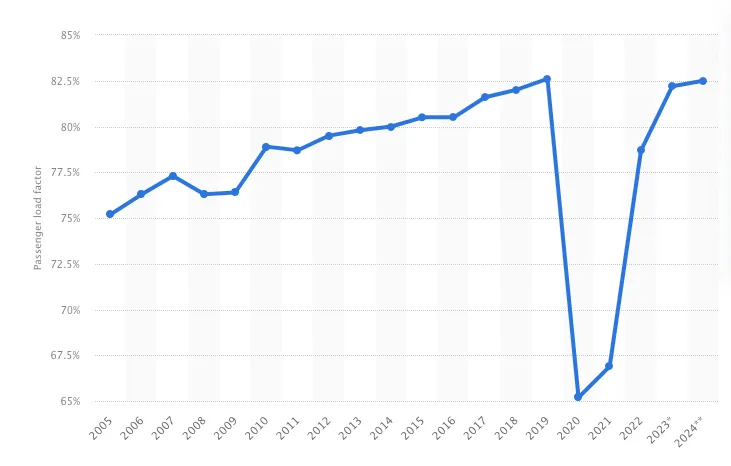
- Demand Prediction, Pricing Optimization, and Load Factor Management: In 2024, the average load factor for U.S. airlines is forecast to be 82.5%, with airlines typically aiming for 80-85% to optimize profitability. Revenue management systems can increase airline revenues. These interrelated challenges form the backbone of airline profitability.
- Customer Service: Real-Time Communication and Personalization: 85% of passengers now expect real-time flight information, and airlines stand to profit further by creating a more personalized customer experience. However, while 92% of aviation leaders believe their customer experiences are at least on par with online retailers, research suggests otherwise.
- Crew Scheduling Complexities: Flight crew costs account for 8.6% of an airline's operating expenses. Optimized crew scheduling can reduce related costs considerably.
- Maintenance: Balancing Safety and Cost: Maintenance expenses account for 8.4% of an airline's operating costs, and unscheduled maintenance events can cost airlines millions per year.
Airline AI: Elevating the Travel Experience
Innovations in airline AI are promising solutions to the six major challenges outlined above. To illustrate how they are already playing a major part in airline operational strategy, let’s take a look at a typical air traveler's day. These innovations—both visible and behind the scenes—are changing the travel experience for billions worldwide, cutting down on costs, flight interruptions, and wasted time for airlines and travelers alike.
Booking Smart with AI-Powered Flight Search
In our example, our hypothetical traveler—Sarah—begins her day at 6 a.m. Eastern. She has a long flight from the East Coast to Los Angeles, with an important connection to make in Denver.
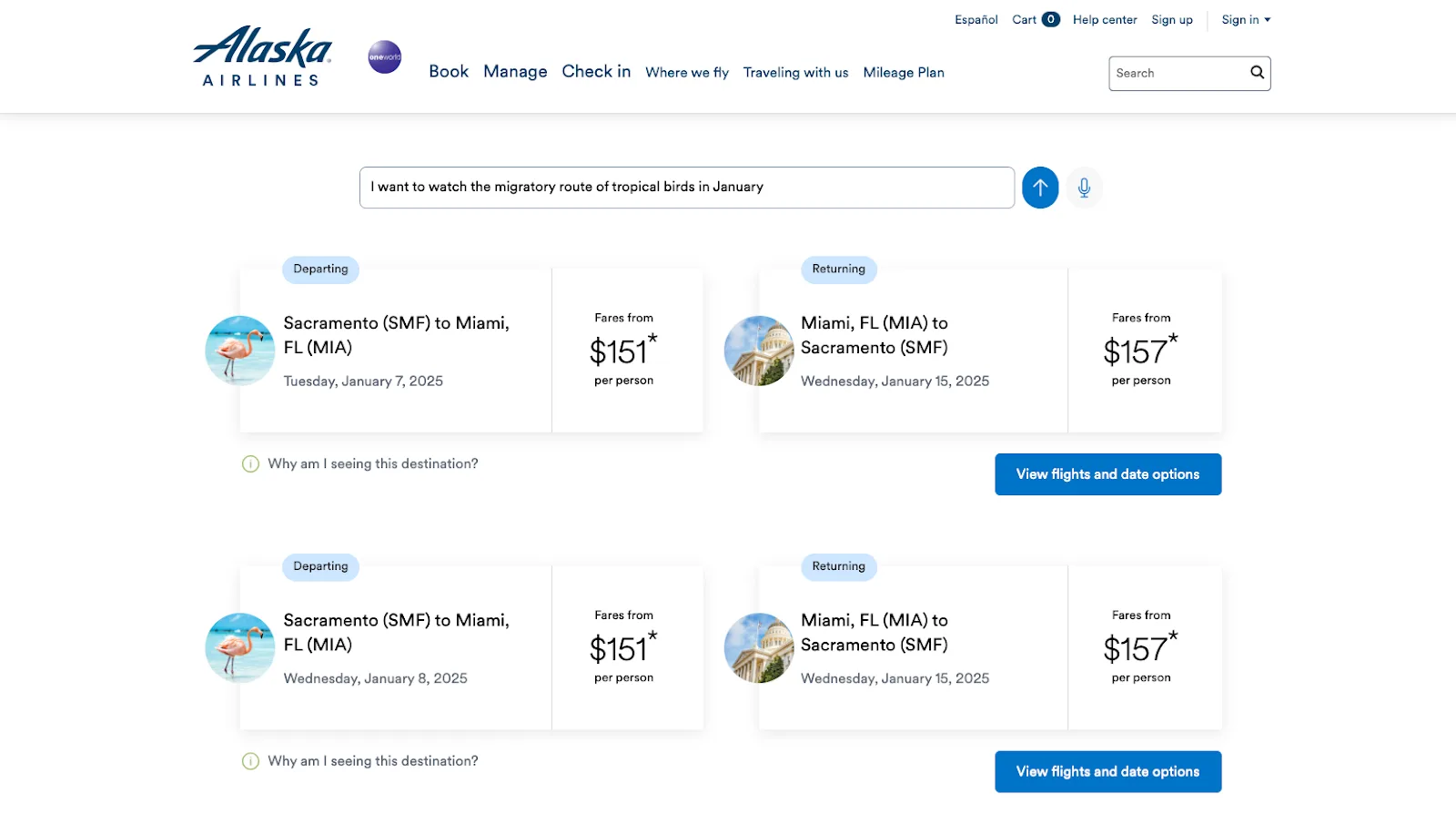
But AI has already been a part of Sarah's journey; in fact, it was at play months ago when she booked the flight she’s now rushing to catch. Innovations like Alaska Airlines' AI-powered flight search tool go beyond traditional search parameters, suggesting destinations based on Sarah's interests and allowing her to search for flights using specific amounts of loyalty points. Concrete data on this particular tool's performance is still being gathered but similar personalized travel planning solutions in other industries have demonstrated impressive results, increasing conversion rates by 30–50% or more.
Predictive Pricing for Better Deals
Back when Sarah booked her flight, she didn’t even realize that an AI-optimized pricing system like the airline AI developed by Fetcherr was playing out in the background. This sophisticated system analyzes a vast array of factors, including competitor pricing, economic indicators, and market trends, to optimize ticket prices in real-time. Fetcherr claims that its AI can improve airlines' revenue by an average of 10%, a substantial figure in an industry where profit margins are often thin.
Fetcherr CEO and co-founder Roy Cohen stated: “Performance improvements typically range in the higher one-digit percentages, with some networks seeing double-digit gains.”
Weather-Smart Flying
While Sarah rides in the back of a Lyft to the airport, airline AI like Lufthansa's AI-driven weather forecasting system is hard at work, demonstrating the power of AI in improving operational efficiency.
In Lufthansa’s case, this system—developed with Google Cloud ML—has achieved a remarkable 40% improvement in accuracy for wind pattern forecasts at Zurich Airport. The implications of this enhanced forecasting capability are far-reaching, helping to reduce delays and cancellations, thereby improving overall operational efficiency, and improving consumer costs and on-time performance.
Smooth Check-In with Facial Recognition
The Lyft Sarah scheduled the night before drops Sarah off at the airport a little late—traffic was slow due to an early morning accident on the highway.
Lucky for Sarah, the airline she’s flying now utilizes facial recognition technology, saving her precious minutes as she makes her way to her gate.
Delta's state-of-the-art facial recognition technology was introduced in 2021, with United now testing it out as well. AI-powered, this system allows passengers to use their faces as their ID and boarding pass at various touchpoints, including check-in, bag drop, security, and boarding.
Proactive Communication for Peace of Mind
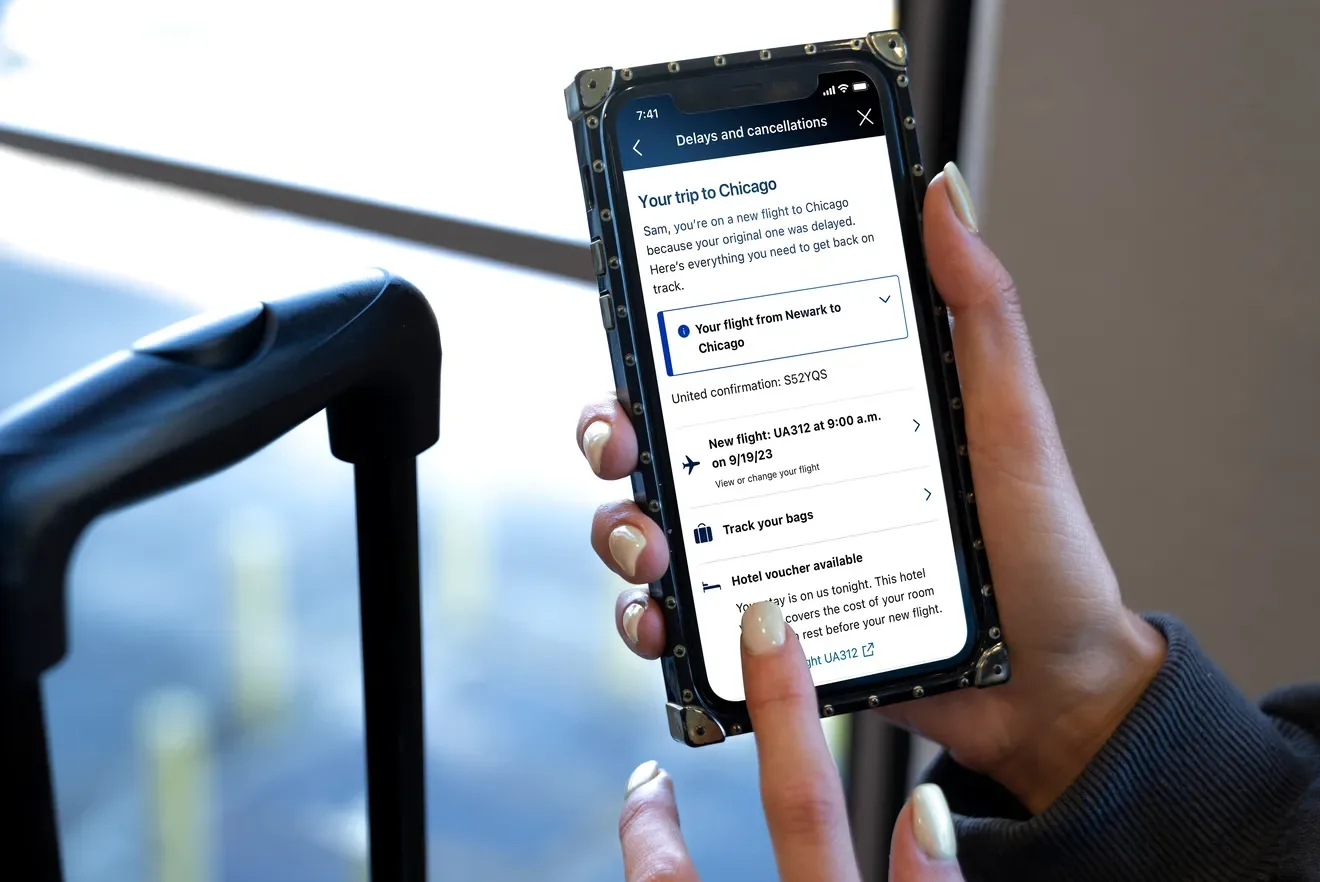
As Sarah waits in line for her morning coffee, wondering if she has enough time, her concern turns out to be unfounded—her flight is delayed. She found out through a tailored text message, completely AI-generated, without needing to hit refresh on her browser or check the departures board.
AI assistants like United Airlines' sophisticated customer support AI explain the exact reasons for delays to passengers like Sarah. For weather-related delays, the system goes a step further, providing links to live radar maps. This level of transparency and detail in communication represents a significant advancement in customer service within the airline industry.
Predictive Maintenance for Reliability
Far before Sarah steps on the plane, airline AI tech like Delta's advanced predictive maintenance system, powered by Airbus's Skywise platform, works silently to ensure aircraft reliability. This AI-driven system has achieved a remarkable 95% success rate in predicting pending failures. The impact of this technology has been dramatic—Delta reduced maintenance-related cancellations from over 5,600 in 2010 to just 55 in 2018.
AI in the Cockpit and Beyond
As Sarah finally boards and puts on her noise-canceling headphones, AI is at work in the cockpit to get her westbound safely.
Airline AI, like Alaska Airlines' Flyways program, can optimize routes in real time. This AI-powered system analyzes a multitude of factors, including weather conditions, aircraft weight, and original routes, to determine the most efficient flight path. The results of the Flyways program have been impressive—during a six-month trial, it saved a substantial 480,000 gallons of jet fuel, not to mention 4,600 tons in carbon emissions.
AI for Smoother Connections
Sarah’s plane was stuck on the tarmac waiting for its gate longer than anticipated, and she’s concerned she’ll miss her flight. Luckily, airline AI technology like United's innovative AI tool, Connection Saver, works behind the scenes to ensure a smooth transition. This system examines flights for connecting passengers and makes real-time decisions on whether to hold departing flights to accommodate them. Given that so many passengers typically have connecting flights, the cost—and frustration—savings of airline AI tech like this is considerable.
Will AI Ever Fly Our Airplanes?
While airline AI is revolutionizing many aspects of air travel, the prospect of fully autonomous commercial passenger flights remains a distant reality. However, AI is already crucial in augmenting pilots through advanced autopilot systems, sophisticated flight planning tools, and real-time optimization algorithms.
The industry is gradually moving towards increasing levels of automation, with some companies exploring concepts like single-pilot operations supported by AI and remote pilots on the ground. These advancements promise to enhance safety, improve efficiency, and potentially address the industry's periodic pilot shortage issues.
However, significant hurdles remain before we see pilotless commercial flights:
- Safety and Certification: Aviation authorities have incredibly high safety standards. To fly a commercial airliner, certifying an AI system would require extensive testing and validation, likely taking years or even decades.
- Public Trust: Convincing passengers to fly on pilotless aircraft represents a significant challenge. A 2017 UBS survey found that 54% of passengers would unlikely take a pilotless flight.
- Regulatory Hurdles: Developing new regulations and certification processes for AI-controlled aircraft will require extensive collaboration between aviation authorities, airlines, and technology providers.
- Handling Unexpected Situations: While airline AI excels at handling routine operations, its ability to respond to unforeseen circumstances or emergencies remains a critical area for development.
- Ethical Considerations: Using airline AI in critical decision-making scenarios raises ethical questions that need to be addressed before full automation can be implemented.
Despite these challenges, airline AI continues to make significant strides in enhancing aviation safety and efficiency. From assisting with takeoffs and landings to optimizing flight paths and fuel consumption, AI is already an indispensable co-pilot in modern aviation.
The Sky's the Limit for Airline AI
As we've seen through Sarah's journey, airline AI is transforming nearly every aspect of air travel. From personalized booking experiences and optimized flight paths to proactive customer service and predictive maintenance, AI is revolutionizing the way airlines operate and how passengers experience air travel.
As AI technology continues to evolve, we can expect even greater advancements in the field of aviation. Potential future developments could include:
- More advanced autonomous systems for aircraft, potentially leading to reduced crew requirements
- Enhanced personalization of the entire travel experience, from booking to in-flight services
- Improved integration of various transportation modes, creating seamless multi-modal travel experiences
- Further advancements in sustainability, with AI playing a crucial role in optimizing operations to reduce environmental impact
Airline AI is not just a futuristic concept—it's a present reality that's reshaping the aviation landscape. As we've seen through the various case studies and Sarah's hypothetical journey, AI is already enhancing efficiency, safety, and the overall passenger experience in numerous ways. While challenges remain, particularly in the realm of fully autonomous flight, the trajectory is clear: the future of aviation is increasingly intertwined with airline AI.